Our journal is on its way. In the meantime, explore how we work or tell us about your inventory.
How it works →Seasonal & overstock
Past-season collections and more stock than your channels can sell.

Good fashion deserves a next chapter. We help brands and inventory owners sell seasonal, excess and returned stock through new markets — with brand-conscious distribution and logistics coordination.

Whatever is holding your stock back, there may be a new way forward. Start with what you have.
Past-season collections and more stock than your channels can sell.
Good products taking up space instead of moving forward.
Returned merchandise reviewed for suitable resale opportunities.
Styles, colors and collections that have reached their final chapter.
Remaining fashion inventory from closing stores or changing operations.
All inventory is reviewed for condition, ownership and resale suitability.
One specialist destination for excess fashion inventory. Every category. Every kind of next chapter.
Moving inventory should not mean giving up your distribution strategy. Set the boundaries. We help explore the right route.
One conversation starts the process. We help you take the next steps, without losing sight of your requirements.
Tell us the categories, quantities, condition and actual pickup address.
Define approved countries, excluded channels and brand requirements.
We review the lot and approach buyers that fit the agreed criteria.
Confirm the buyer, price, service fees, payment terms and shipping responsibilities.
Arrange the agreed pickup, handover and shipment with the relevant parties.
A buyer is only part of the picture. We help coordinate the agreed handover, pickup and shipping plan, so your inventory has a practical route out of your warehouse.
Shipping scope, costs, timing and responsibilities are agreed for each transaction. Routes remain subject to product and destination requirements.
 From warehouse
 Global distribution
Illustrative stock photography, not REMEX facilities or fleet.
Looking for fashion inventory? Tell us your categories, market and buying volume. Join our buyer network to be considered for relevant opportunities.
 Your next assortment.
Every inventory situation is different. A little clarity goes a long way.
Fashion-related stock, including apparel for women, men and children, footwear, bags, hats and other accessories. You can submit overstock, past-season collections, slow-moving products, discontinued lines, store-closing inventory and customer returns. Returns and mixed-condition lots are reviewed for resale suitability.
You can propose approved or excluded countries, export-only requirements, offline-only resale and restrictions on online marketplaces. Available routes and controls are reviewed for each transaction and must be agreed with the relevant parties. They are not a guarantee against every possible downstream resale.
This service is designed around inventory review, sales representation and buyer matching, rather than an automatic purchase offer. We discuss suitable opportunities with you. Pricing, service fees, payment terms and logistics responsibilities are agreed before a transaction proceeds.
A detailed list is helpful, but you can start with a category, approximate quantity, stock location and a brief description. Use the notes field to explain what information is still being checked. Attach an Excel, CSV or PDF file when available.
Use the buyer form to share your business details, preferred categories, purchasing volume, destination markets and sales channels. Registration is an expression of interest, not a guarantee of stock availability or approval for every lot.
No obligation. Just a good place to start.
We help fashion inventory owners explore new markets for products that no longer fit their primary sales channels. The goal is not simply to move stock. It is to find the right next destination.
Off Fashion is a fashion-focused inventory resale and brokerage service, powered by REMEX Liquidation Inc. We work with brands, retailers, distributors and other authorized inventory owners.
From seasonal apparel and surplus footwear to returns, discontinued accessories and store-closing stock, our starting point is understanding what you have and what matters to your business.
We help identify potential buyers and alternative distribution routes, with market restrictions, channel requirements and commercial terms reviewed before a transaction proceeds.
Our focus is apparel, footwear, bags and accessories. A dedicated starting point for the practical details of fashion stock.
Country exclusions, channel requirements and buyer fit belong in the conversation from the beginning.
Our US and Asia locations support conversations about alternative markets and cross-border resale opportunities.
Across the United States and Asia, our locations reflect a business built around connecting inventory with its next opportunity.
 CA.
CA.United States
TX.United States
 SH.
SH.China
 PG.
PG.South Korea
No obligation. Just a good place to start.
Practical ideas for preparing inventory, defining distribution boundaries and starting a more useful resale conversation.
No obligation. Just a good place to start.
Share your inventory and distribution requirements. We will use them as the starting point for a conversation.
Share your stock, define your boundaries, review the right buyers and coordinate the move. We facilitate resale opportunities — we do not promise an automatic purchase.
One conversation starts the process. We help you take the next steps, without losing sight of your requirements.
Tell us the categories, quantities, condition and actual pickup address.
Define approved countries, excluded channels and brand requirements.
We review the lot and approach buyers that fit the agreed criteria.
Confirm the buyer, price, service fees, payment terms and shipping responsibilities.
Arrange the agreed pickup, handover and shipment with the relevant parties.
You do not need a perfect stock list to start. Share the basics first. Add a stock-list link, photos or more detail when available. Files can be shared through an agreed secure upload process.
Share your actual business address, resale destinations, product preferences and preferred language. We use this information to discuss relevant inventory opportunities, not to promise ongoing stock availability.
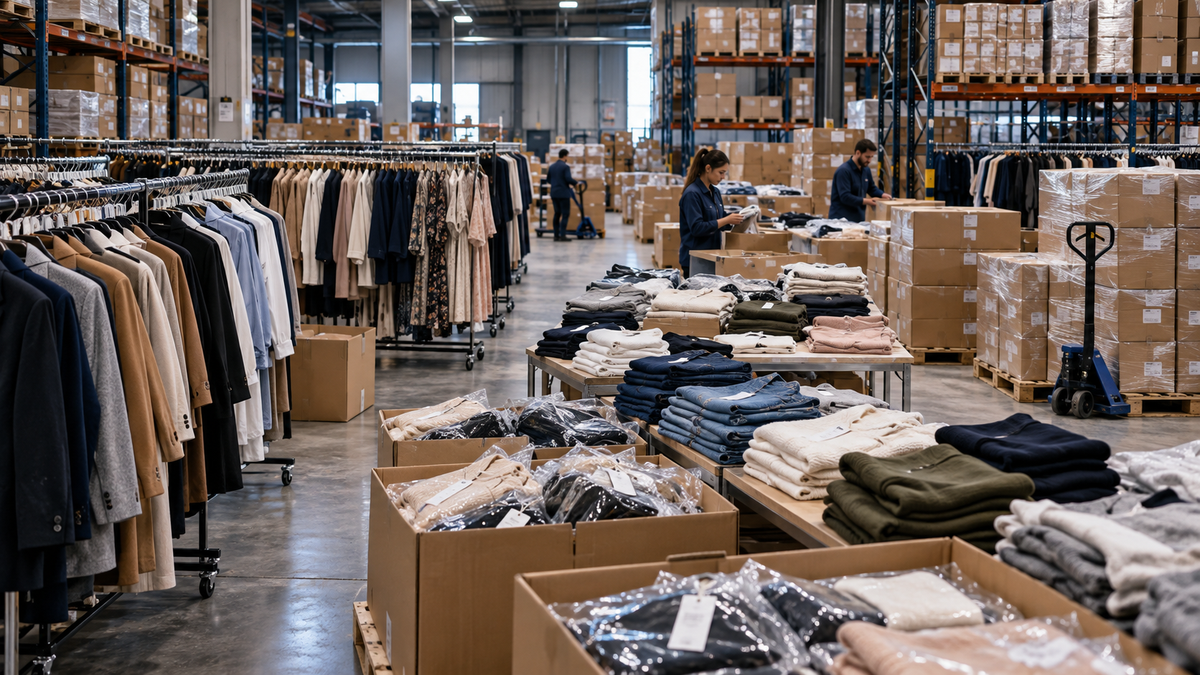
Excess inventory is a normal part of the fashion business.
Seasonal changes, overproduction, customer returns, discontinued styles, store closures, and changing consumer demand can all leave brands and retailers with products that are still valuable — but no longer fit their primary sales channels.
The challenge is not simply getting rid of the inventory.
The real challenge is finding a way to recover value without damaging your brand, disrupting existing retail relationships, or creating unwanted price competition.
That is where a more controlled approach to fashion liquidation becomes important.
Excess fashion inventory refers to products that are no longer moving through a brand or retailer’s primary sales channels.
This can include:
In many cases, these products are still completely sellable.
The issue is simply that they need a different market.
Selling excess inventory to the first available buyer may solve a warehouse problem, but it can create other problems for the brand.
For example, deeply discounted products may appear in the same market where the brand is still selling at full price.
Inventory may also end up on online marketplaces, discount websites, or regions where the brand does not want the products to be sold.
This can lead to:
For that reason, fashion liquidation should be about more than finding the lowest price.
It should also be about controlling where and how the inventory is resold.
Before selling excess fashion inventory, brands should clearly define any resale restrictions.
Common restrictions may include:
Inventory can be sold outside the brand’s primary domestic market.
This can be useful when a company wants to avoid competing with its existing retailers.
Products can be restricted from major online marketplaces or e-commerce channels.
Inventory can be sold through physical retail stores, discount stores, wholesalers, or other offline channels.
Specific countries or regions can be excluded from distribution.
Brands may request that inventory not be sold on certain third-party marketplaces.
These restrictions can help brands recover value while maintaining better control over their distribution strategy.
One of the most important steps in selling excess inventory is preparing a complete inventory file.
A good inventory list should include:
Excel or CSV files are usually the easiest format for large inventory opportunities.
The more information buyers receive upfront, the easier it is for them to evaluate the inventory and make an offer.
Not every wholesale buyer is suitable for liquidation inventory.
Secondary-market buyers often specialize in specific categories, countries, quantities, or resale channels.
Some buyers may specialize in:
They may also purchase inventory in different volumes, including:
Matching inventory with the right buyer can make it easier to move larger quantities while respecting the seller’s requirements.
Logistics can determine whether a fashion liquidation deal actually closes.
Before offering inventory to buyers, it is helpful to know:
Providing this information early helps buyers better understand the total cost of the transaction.
It also reduces delays once an agreement is reached.
Excess inventory that is difficult to sell in one market may still have strong demand somewhere else.
Different countries have different consumer preferences, retail structures, price points, and product demand.
A past-season collection that may no longer perform well in one country could still be attractive inventory for a buyer in another market.
This is why international distribution can be an important part of fashion liquidation.
Exporting excess inventory can help brands reach new buyers while reducing conflict with their existing domestic sales channels.
Off Fashion connects fashion inventory owners with buyers looking for excess, overstock, returned, discontinued, and past-season merchandise.
Our goal is not simply to move inventory.
We help sellers explore new markets while taking their distribution requirements into account.
The process is simple.
Tell us what products you have, how much inventory is available, and where the inventory is located.
Let us know about any export restrictions, online restrictions, offline-only requirements, marketplace restrictions, or other distribution conditions.
We review the category, condition, quantity, location, price expectations, and resale requirements.
Relevant opportunities can be introduced to buyers based on their preferred categories, markets, purchasing volume, and sales channels.
Once a transaction is agreed upon, logistics can be coordinated to move the inventory to its next market.
Off Fashion works with a wide range of fashion inventory, including:
We also work with different types of inventory situations, including:
Excess inventory does not always mean the product has lost its value.
Sometimes the inventory simply needs a new buyer, a new country, or a different sales channel.
The goal should not only be to ask:
“How can we get rid of this inventory?”
A better question is:
“Where can this inventory create value without disrupting our existing business?”
That is where a structured secondary-market strategy can make a difference.
If you have excess apparel, shoes, bags, accessories, past-season inventory, returns, or discontinued products, submit your inventory to Off Fashion.
Tell us what you have, where the inventory is located, and any distribution restrictions that are important to your brand.
Sell Your Inventory with Off Fashion.